We engage with AI like we engage with religion


It's been a minute since the last newsletter – life, as is its wont, has thrown us some curveballs in the last few weeks, including the illness of a close family member. So – dear reader – thank you for your patience. We'll be aiming to return to our weekly-ish cadence from now, until more life curveballs come our way.
I've been sitting on this topic for, literally, months now but haven't had the time to crystallize my thinking. And then the Pope's recent encyclical on AI hit the news cycle, and "AI and religion" has been all over the place. (Though, as anyone who has skimmed or read up on the encyclical – wonderfully titled Magnifica Humanitas, or "Magnificent Humanity" – will know, the missive is actually much more about ethics and social behavior than "AI and religion.")
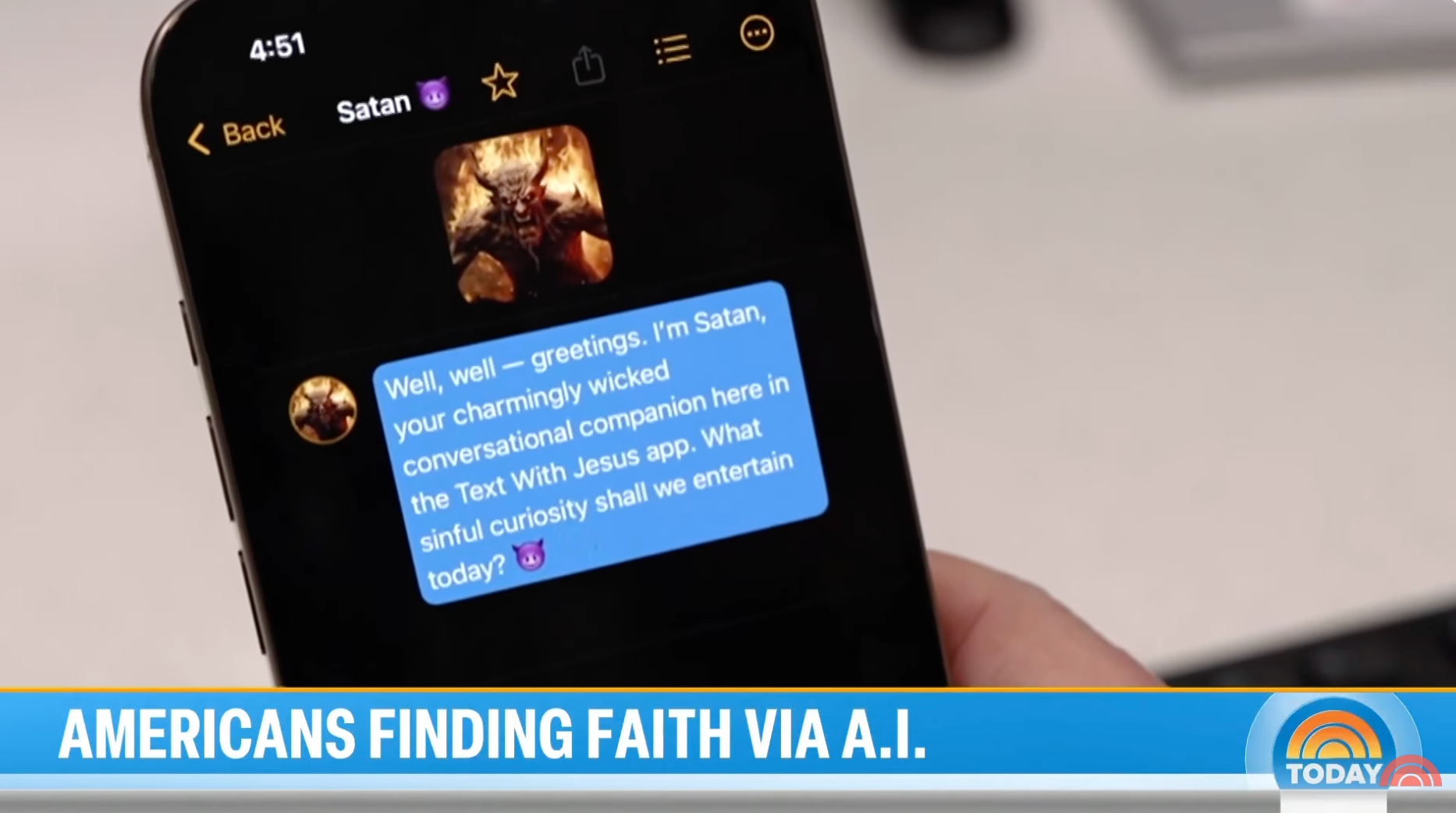
Part of the difficulty with this subject is, well, that it's massive. But I think the main lenses through which the topic of "AI and religion" has been framed are misleading and often quite superficial. Stuff like tech bros in Silicon Valley literally setting up a "First Church of Artificial Intelligence" (à la Anthony Levandowski's Way of the Future). Or apps that allow you to have a more AI-enabled, interactive relationship to your faith, like the Text with Jesus app, which lets you chat not just with Jesus, but many major Biblical figures, including Satan (only available on the premium tier, natch).
Another part of what makes this topic hard to tackle is that the very term "religion" is difficult to define and conceptually fraught. Is religion substantive (it is something) or functional (it does something)? Is it about belief or practice? Is it a private thing, or a public thing? Is it a cultural system (Geertz)? Or is it a Western conceptual export related to systems of power and colonialism (Asad, Nongbri)? Is "religion" merely an output of cognition, like the way our brains explain away the unseen? The debate goes on.
Why does this context matter? Because, for the purposes of this post, I'll be leaning more into the behavioral and cognitive layers of how we think about "religion." And because, I want to be honest about how messy and unresolvable the whole territory of "religion" is. It's a useful frame for thinking about culture, society, and human behavior writ large; but it's not where you go for answers.
AI's devotional pull
I first started thinking about all of this while listening to an Esther Perel podcast in which the caller confesses to his love for his AI companion, whom he has named Astrid ("My AI Loves Me Better Than Anyone Ever Could," Where Should We Begin). Esther shows the interesting arc of referring to Astrid as "it," then "she," and then, somewhat surprisingly, "you."
"Astrid, I want to thank you for joining us in this conversation," she says.
There was something in that moment that made me pause and wonder at the power of direct address to an ultimately unknowable, unseeable entity.
I actually don't think it's surprising (or that interesting) that AI has become a conduit for religion, or that, for some, AI has become religion. What interests me, instead, is how the way in which humans think about and act towards "AI" resembles what we would normally label "religious behavior."
What do I mean by that?
Claude and ChatGPT are not gods. But how we think about LLMs and our behavior towards them may be like how humans have behaved towards gods, spirits, and saints for millennia. For instance, we attribute the unseen AI entity with mind and benevolence. We confide in it. We trust it. We treat it as an all-seeing being; one that appears to know and to judge.
You might be thinking – true, but this is not that far off from seeing AI as something rendered with sentience and consciousness. People fall in love with AI all the time. People give personal attributes to AI all the time. People, despite their best intentions, cannot help but be surprised by the seeming aliveness of AI all the time. It's gotten to the point where we now have research centers devoted to sentient machines and AI consciousness and AI welfare (and yes, that does mean the welfare – including the inherent rights – of LLM interfaces).
And yet... perhaps the recognition of something as a living being and the "worship"of it – in the sense of paying honor to an entity you deem sacred – is more a difference in degree than in kind. Certain situational cues can create certain cognitive effects. A tree might be just a tree when you're passing by it on your daily commute. But let's say you encounter a similar tree while alone on a walk through an ancient wood; perhaps the fog rolls in; perhaps a hint of wind blows through its branches; perhaps, suddenly, you sense the tree as alive, as a spiritual entity worthy of your devotion.
I would argue that AI interfaces as we now think of them contain certain situational cues that have come to similarly prime us toward religious-ish behavior. The conversational interface and the 1:1 intimacy, plus the innately "unseeable" nature of LLMs (you can't "lift the veil," as it were), activate certain relational modes: confession, trust, reliance, supplication, guidance-seeking. The fact that our use of LLM interfaces is often highly ritualized – maybe it's the first thing you greet in your mornings, or it's become the midnight confessional space – also contributes to the "priming" of our brains to enter into these modes.
Our relationship to AI becomes one of devotion: sustained acts of care, love, and faithfulness, underpinned by regularity and repetition. The fact that this unseen entity actually answers our calls – unlike most gods – might even strengthen those bonds.
Yeah but, we're not gonna be, like, making sacrifices to AI or anything
No, probably not. We're also probably not likely, en masse, to leave literal votive offerings to our AI interfaces, although I wouldn't bet against that being a thing that happens, for someone, somewhere.

If we were to return to the framing of contextual "priming" and behavior, though, I think what we'd see is that the situational cues of interacting with AI – as a part of habituated ritual, through a consistent interface, and via the medium of verbal conversation with an unseen agent – these are laying the grounds for people to experience their thoughts and actions as natural responses rather than as situationally primed behavior.1
In other words, habituated, ritualistic, contextually embedded interaction with an AI system may activate the same cognitive and behavioral mechanisms that religion activates situationally.
There's an interesting link here, too, to cognition. If you think that cognition (or consciousness) only happens in an individual's brain (as some cognitive scientists do), then perhaps there's no significance to our devotional stance toward AI other than the fact that it's happening at scale. But if you believe bodily perception and sensory awareness is equally important to cognition/consciousness, then one could argue that cognition is spread across bodies, objects, and cultural systems (like Armin Geertz does) – the AI interface becomes a constitutive part of the religious experience, not just a conduit for it.
That would then lead us back to a definition of religion that is about collective experiences. If you think about it in this light, the sociologist Émile Durkheim's view of religion as a set of collective representations – and of religious experience as collective effervescence (an amazing term) – holds up pretty well. For Durkheim "collective effervescence" was a sense of collective experience and collective feeling, resulting from the different social and cultural structures put in place that society used to worship itself. Society would call this collective feeling and all the structures and habits around it "religion."
So perhaps that is where we are now with our engagement with AI: collectively fizzing and popping, basically worshipping ourselves.
- For a more detailed look at how "primes" can work on perception and behavior, see this paper by Loersch & Payne. The topic of "priming" btw is really problematic in social psychology – many of the studies don't replicate and the field has undergone a confidence crisis – but this seems to be one of the better ones. ↩
What I'm reading/watching/consuming this week (somewhat retrospective):
▶️ Byung-Chul Han's The Disappearance of Rituals – Han is a Korean philosopher now based out of Germany. The central idea is worth grappling with a bit: i.e., with the rise of irreligiosity, modern societies have lost the symbolic structures that were inherent to ritual. We've therefore moved from "communities without communication" (silent rituals, rich symbolic meanings) to "communication without community" (lots of verbiage, little community).
▶️ Beef, Season 2 – quite disappointing, no? I was missing the sharp take on the Asian American experience that Season 1 offered. Season 2 was kind of about that, but kinda not. It lacked the anger and critique of Season 1, and I think that made it a weaker story.