Are Gen Z Boys Truly Raging Misogynists? (Gen Z Boys: Part 2)


This is Part 2 of a two-part post about Gen Z boys and misogyny. Part 1 was about how the manosphere operates like global K-pop fandoms. Part 2 is about whether Gen Z men are actually more misogynistic than Boomers – and why we need to treat surveys in general, and attitudinal surveys in particular, with great care. This one is a bit of a deeper dive – strap in. 😉 And if you find this useful, please share widely – I think it's an important precaution about surveys in the news cycle.
Recently, there has been a news headline making the rounds based on a survey conducted by Ipsos on behalf of the Global Institute for Women's Leadership at King’s College London. The headline and takeaway: "Almost a third of Gen Z men agree a wife should obey her husband." The implication of the reporting—which ranges from The Guardian and USA Today to the BBC and ZME Science—seems to be that men are regressing, Red Pillers are taking over the world, and there may be no way out of this spiraling testosterone mess fueling a regression in gender equality.

The idea that Gen Z men are significantly more misogynistic than Boomers has been floating around for a while, but it has recently received a newsbeat boost thanks to that Ipsos/KCL survey (conveniently timed to coincide with International Women's Day 🤔 ). And it is being quoted everywhere.
As a consumer insights and market research consultant with experience overseeing both quantitative and qualitative surveys, I think that this survey is misleading. Although at first glance everything looks above board – the survey is linked with Ipsos, a big reputable survey company, and KCL – there are reasons why we should not take headlines and surveys like this at face value.
To verify my concerns with the survey, I spoke to a couple of experts: Dr. April Bailey, a social psychologist specialising in gender biases at the University of Edinburgh, plus an applied statistician and a child behavioral psychologist, also at Edinburgh – all of whom regularly work with survey data in their academic research..
Based on these conversations, my own research, and my previous experience with conducting surveys, while I do think that the radicalization of young men by the manosphere is extremely concerning, I do not think that Gen Z boys and men are necessarily more misogynistic than Boomers. Here's why.
How to Read and Analyze a Survey
A couple of things immediately popped out at me when I actually clicked open the PDF of the survey results. One of these has to do with how participants of this survey were sampled, divided into subgroups, and analyzed across those subgroups. The second has to do with how the questions in the survey were asked.
📌 Point 1. How you recruit, sample, and group participants really actually matters, like, a lot
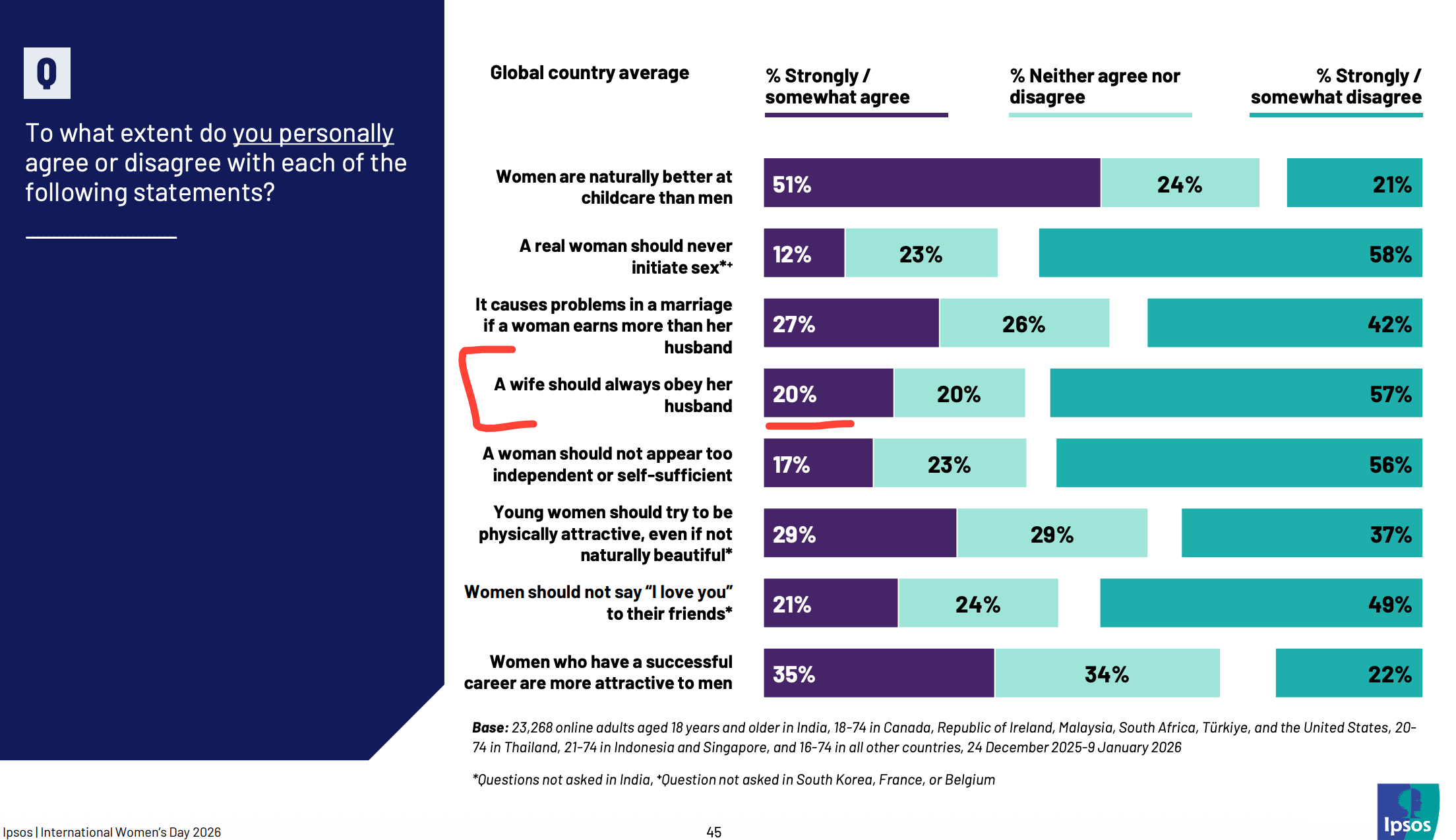
First, on the subgroups. This survey presents results across four generational divisions (Boomers, Gen X, Millennials, and Gen Z) from a single point in time, meaning we can get a sense of how each generation answers a given question – but we cannot know whether this is attributable to different life stages VS whether it is indicative of an actual attitudinal difference that persists over time for each subgroup. In other words, a Boomer male will have a lot more lived experience than a Gen Z male – and the survey gives no indication whether Boomers' more forgiving views of women's equality (as in the graph below) is due to their longer lived experience or to an inherently less misogynistic attitude that is somehow characteristic of men born in the 1940s–1960s.
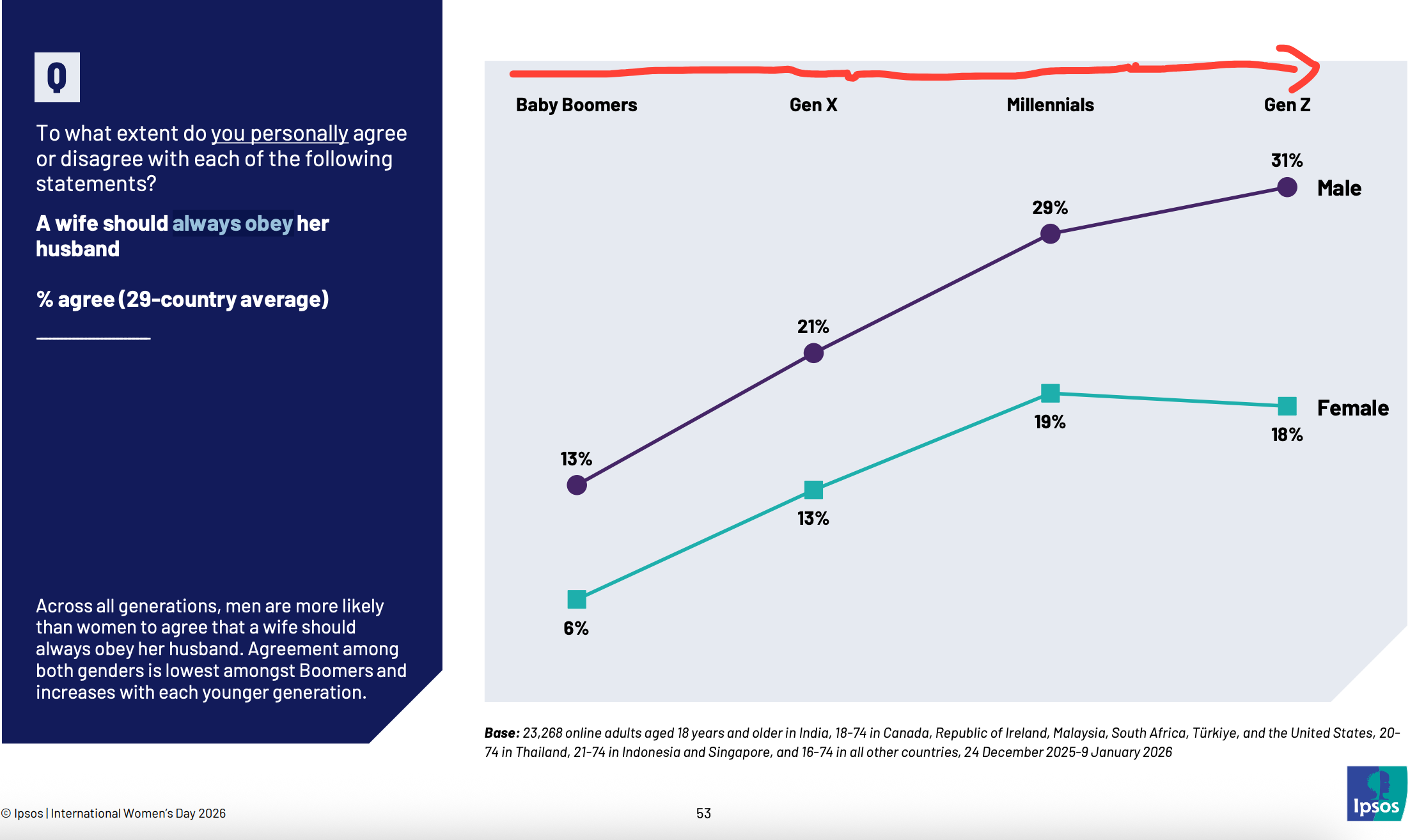
"We're doing apples to oranges comparisons [with] cross-sectional vs longitudinal data," Dr. Bailey noted during our conversation. "We don't know how Boomers would have answered this question in their 20s."
Second, on recruitment methodology. Buried deep at the bottom of Ipsos' 98-page survey report is a little note that says the company used its "Global Advisor online platform" to conduct this survey. That seems innocuous, but it's actually a pretty major limitation in a survey that is asking such sensitive and nuanced questions about social constructs. By "Global Advisor online platform," Ipsos means an online opt-in panel – where people sign up to take surveys, often for cash or rewards. It's understandable why Ipsos used this recruitment method – it's cheap and fast – but this means that the survey results are NOT based on random probability sampling, and that the method will introduce some degree of unknowable, unmeasurable bias. As my applied statistician acquaintance told me – for the survey results to be accurate, you'd have to assume that there was an equal probability of a misogynistic Boomer signing up for this kind of survey platform as a misogynistic Gen Z'er. Are women-hating 20-year-olds just as likely as women-hating 60-year-olds to take a super-long survey about gender during the Christmas and New Year's holidays? Who knows. 🤷🏻♀️
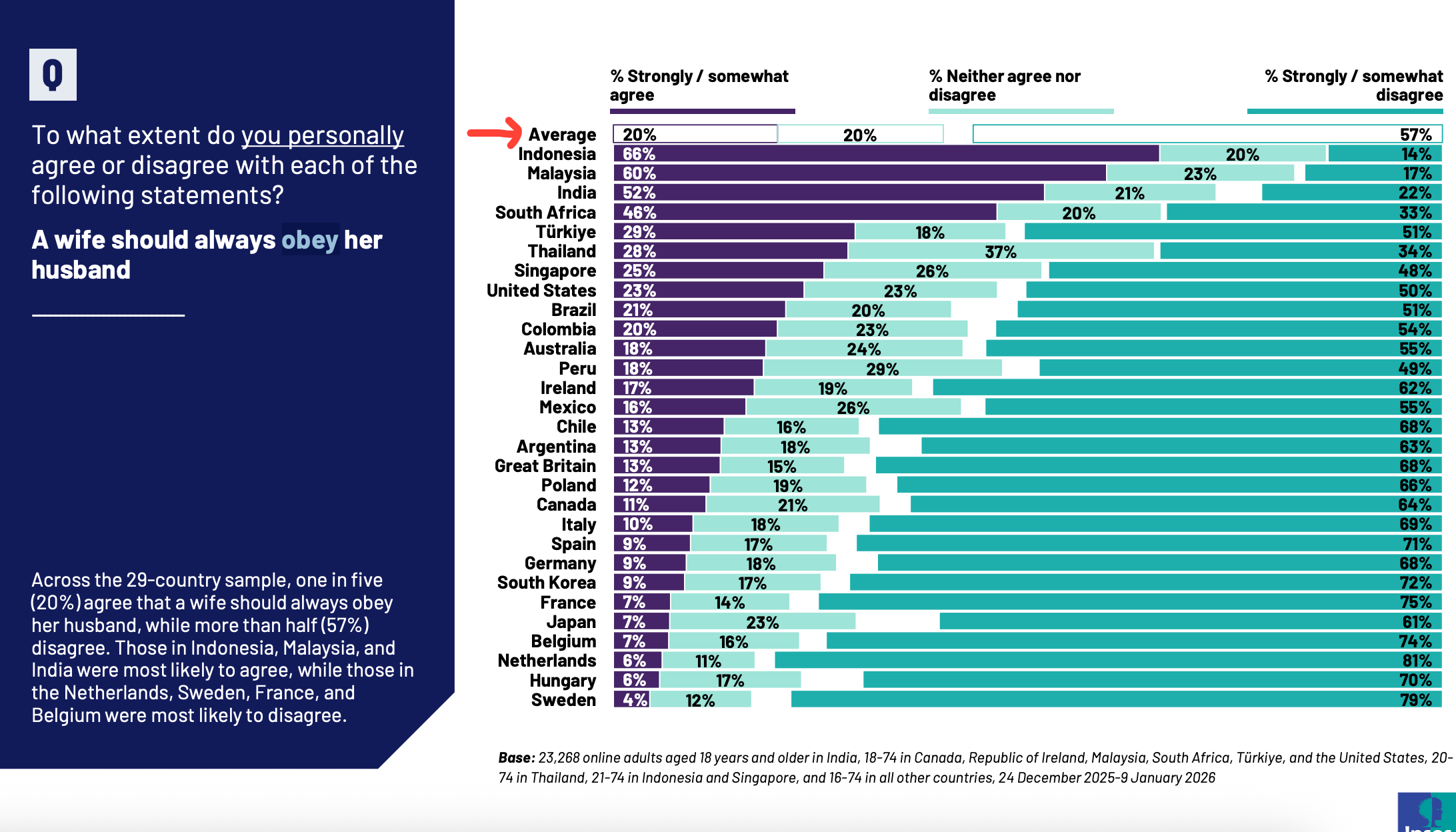
Third, on topline analysis. This survey presents country averages as evidence for its topline takeaways. When you consider how differently countries skew by age cohort – for instance, India skews very young, South Korea and Japan much older – a simple "global country average" becomes problematic in a survey also stratified by generation. Not to mention the significant socio-cultural differences across different countries.
📌 Point 2. It also really really matters how you ask questions.
This is a 29-country global survey. That's 29 different cultures, and 29 different systems of cultural & social norms. How many ways and contexts are there to ask about agreement for a statement like, "Men should not say 'I love you' to their friends" Or "A wife should always obey her husband"? The sentiment of love might be expressed in a thousand different ways among friend groups, including all-male ones, but the actual phrase "I love you" may or may not be typical of your specific group context or cultural setting. It would take a skilled interviewer to be able to gain real insight into this kind of question – to be able to get to the question behind the question – in a way that an online "yes/no/don't know" type of survey simply cannot get at.
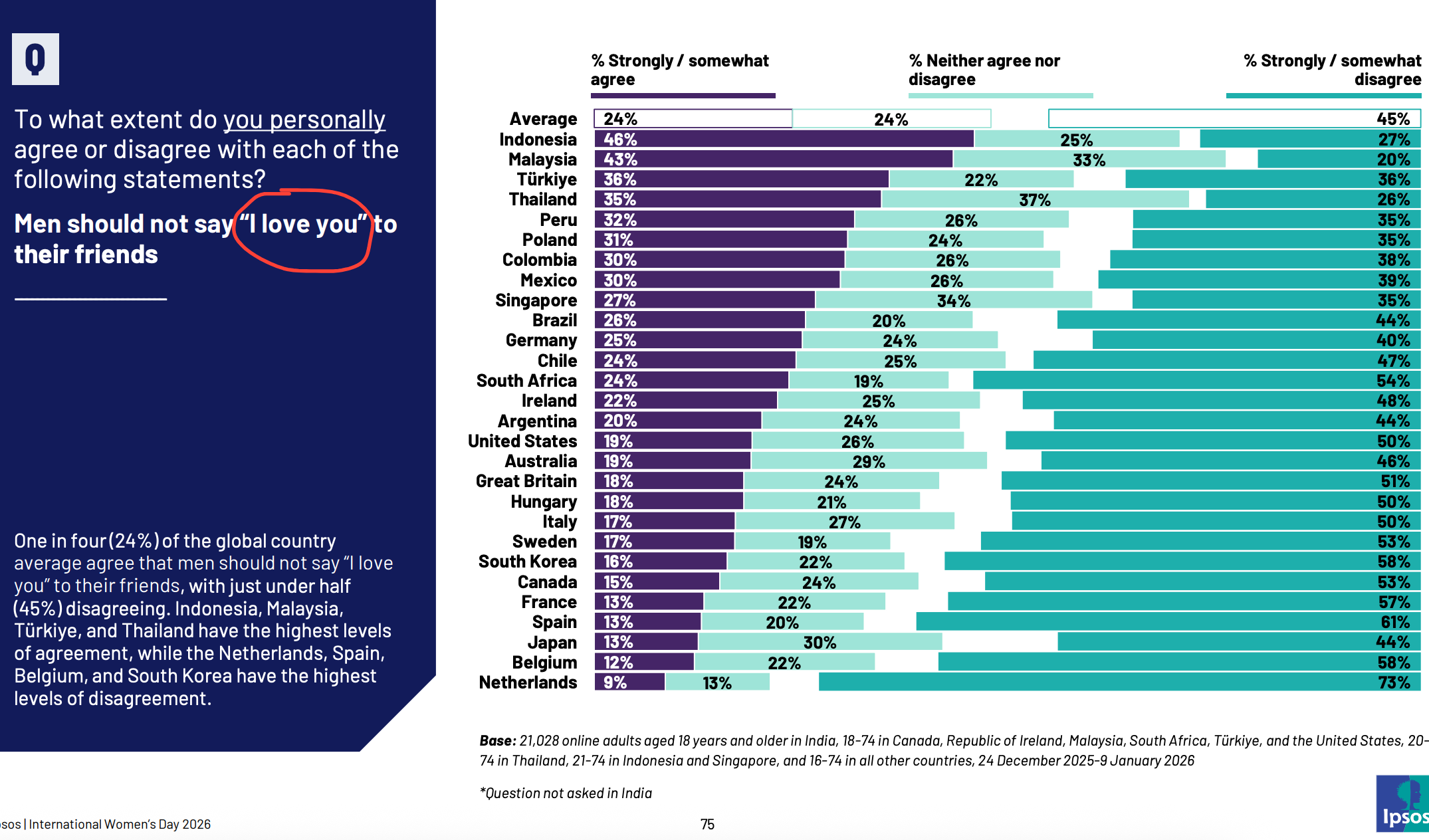
For me, this report raises a lot more questions than it answers. Dr. Bailey noted that "There are established ways to go about assessing these kinds of gender beliefs," she said. "Measures with good scale validation and psychometric properties do exist." For instance, she pointed out, a psychologist would try to measure the same thing using multiple different types of questions. I would add that good consumer interviews normally also do the same. So much of how we express meaning depends on context; and a big part of this kind of study should ideally be to understand and parse that context.
There was no way that a survey of this scale and scope could have been conducted to the kinds of standards that it perhaps deserved in such a short time frame. But we need to understand those limitations in order to truly assess its results.
TL;DR
No, Gen Z boys are not necessarily twice as likely to be more misogynistic than Boomers. Yes, you should approach these kinds of consumer surveys with some degree of skepticism & read the fine print.
OK, so are Gen Z boys misogynists or not?
In short, again, no, but it depends on the country and the context: "we are seeing overall a general decline in traditional gender attitudes, at least in the U.K. and the U.S." (Bailey) – but there may be some causes for concern.
Underlying the Ipsos/KCL survey results and the reporting around it, I think, is an assumption that niche online extremist communities like the manosphere writ large are primary drivers of a growing gender divide. But, I suspect, the causes and contexts are more complicated than that, and are happening at a bigger structural level. The manosphere is, I would argue, more symptom than cause.
It's true that social media is an amplifier of the loudest voices, and often, those voices can dominate our attention even though they are, relatively speaking, quite niche. The amplification of those voices may, therefore, be having a very real effect. There is, for instance, evidence in the social psychology literature that points to a phenomenon called “pluralistic ignorance,” which refers to a discrepancy between public actions and private sentiments driven by individuals’ desire to be seen as belonging to a group, even if their own privately held views diverge from those of the larger group. Applied to gender norms, this could result in people being aware of and acting out more traditional gender ideologies than they themselves privately endorse, precisely because they consider those traditional ideologies to be normative for their group.
What's worrying about the manosphere in Louis Theroux's deep dive documentary (discussed in the last issue of The Percolator) is that its influencers and followers endorse not just a negative and explicitly misogynistic attitude towards women, but also a favorable and paternalistic one. It seems counterintuitive, but the psychological literature shows that negative, extremist, and hateful attitudes towards women are positively correlated with favorable yet paternalistic attitudes towards women. In other words, Justin Waller's "I love women" paternalism goes hand-in-hand with Myron Gaines' "Why Women Deserve Less" misogyny. (Incidentally, this is why I mentioned in the last post that the trad wife phenomenon absolutely needs to be considered alongside the manosphere.)
So yes, there are definitely reasons to worry. The loneliness epidemic is real; weakening social bonds and community ties are real; a growing radicalization of views on gender is real; social media stepping in to fill some of these gaps through parasocial relationships is also real. And it goes without saying that misogynistic and paternalistic attitudes and behaviors are, of course, very much real.
How we address misogyny and the potential growing extremeness around it is as much about teaching the value of social relationships and communal ties, gender equality and its very long history ofstruggle, as it is about teaching young people about online literacy. This is not unique to Gen Z or Gen Alpha – they are simply the latest victims.
What I'm reading/watching/consuming this week:
▶️ Caroline Weaver, Pencils You Should Know (a little anthropological history of a million different pencils – VERY FUN)